remote collaboration tools for dissertation writing

The Remote Dissertation Revolution: Why Location No Longer Limits Your Success

Gone are the days when dissertation writing meant endless hours in isolation, limited by geographical boundaries and rigid schedules. Today’s doctoral researchers are embracing a collaborative revolution that’s transforming how we approach academic research. Whether you’re working with an advisor across the country or collaborating with peers from around the globe, remote collaboration tools have become essential for dissertation success.

The shift toward remote research isn’t just about adapting to changing circumstances, it’s about unlocking opportunities that traditional, location-bound collaboration simply cannot offer. This comprehensive guide will show you exactly how to leverage the best remote collaboration tools and strategies to streamline your dissertation journey.

Why Remote Collaboration Is Your Dissertation’s Secret Weapon

Expand Your Academic Network Beyond Campus Boundaries

Remote collaboration breaks down geographical barriers, allowing you to work with the most qualified advisors and peers regardless of their location. That expert in your field who moved to another institution? Still accessible. The brilliant graduate student conducting complementary research at a university across the globe? Now a potential collaborator.

Maximize Flexibility and Efficiency

Remote tools enable asynchronous work that fits your schedule and your advisor’s busy calendar. No more waiting weeks for a 30-minute in-person meeting. Quick feedback loops, reduced travel time, and the ability to work when you’re most productive all contribute to a more efficient research process.

Access Diverse Perspectives and Expertise

Working remotely naturally exposes you to a wider range of viewpoints and methodologies. This diversity strengthens your research and helps you anticipate questions and critiques before your defense.

Build Future-Ready Skills

Mastering remote collaboration tools isn’t just about completing your dissertation—it’s about developing skills essential for modern academic and professional careers. These competencies will serve you well in post-doc positions, academic jobs, and industry roles.

Essential Tool Categories Every Dissertation Writer Needs

Successful remote collaboration relies on four core categories of tools, each serving a specific purpose in your research workflow:

  1. Document Collaboration & Co-authoring Tools – For shared writing and editing
  2. Communication & Virtual Meeting Platforms – For real-time discussions and check-ins
  3. Project Management & Task Tracking – For organizing tasks, deadlines, and progress
  4. Cloud Storage & File Sharing – For secure access to large files and datasets

 Best Remote Collaboration Tools In Your Dissertation Journey

After years of remote dissertation work and countless conversations with successful doctoral graduates, here are the tools that consistently deliver results:

Document Collaboration Champions

Google Docs and Microsoft 365 (Word Online) excel for prose-heavy sections like introductions, literature reviews, and discussions. Real-time co-editing allows you and your advisor to work simultaneously on the same document, while the commenting system creates a structured feedback process. The key to success lies in establishing clear commenting etiquette with your advisor—using suggestions mode for all edits and creating a consistent system for resolving comments. The version history feature becomes invaluable when you need to track major revisions or recover lost work.

Overleaf is essential for STEM dissertations requiring complex formatting, equations, or citations. This platform provides seamless collaborative LaTeX editing with real-time compilation, making it perfect for technical documents. The magic happens when you integrate Overleaf with reference managers like Zotero or Mendeley, utilize its built-in commenting system for targeted feedback, and take advantage of git integration for advanced version control.

Communication Powerhouses

Zoom and Google Meet shine for scheduled meetings involving screen sharing, data discussion, or collaborative outlining sessions. These platforms become most effective when you prepare meeting agendas in advance, use the recording feature to capture important decisions (with consent), and master screen sharing to walk through drafts, data visualizations, or research materials together.

Slack and Microsoft Teams are perfect for quick questions, informal discussions, and creating dedicated channels for different dissertation aspects like methodology, analysis, and writing. Success with these platforms requires setting clear boundaries for response times to maintain work-life balance, organizing channels logically, and using threads to keep conversations organized and searchable.

Email remains crucial despite newer tools, especially for formal communications, large attachment sharing, and official approvals. Effective email collaboration depends on crafting clear, specific subject lines, keeping messages concise but complete, and following up respectfully when responses are needed.

Project Management Game-Changers

Trello and Asana are visual project management tools that help you track progress using customizable boards like “To Do,” “In Progress,” “Under Review,” and “Complete.” The secret to success with these platforms is keeping your system simple, complex setups often go unused. Regular updates maintain momentum, and these tools work best when tracking both individual tasks and collaborative deadlines.

Shared Calendars through Google Calendar or Outlook are essential for coordinating meeting times, deadline reminders, and dedicated writing blocks. They become powerful when you color-code different types of activities, set up automatic reminders for important deadlines, and block out focused writing time just like any other important appointment.

File Management Foundations

Google Drive, Dropbox, and OneDrive serve as your dissertation’s central nervous system, providing secure, accessible storage for all research materials. Success requires developing and maintaining a clear folder structure from day one, using consistent file naming conventions that include dates and version numbers, and understanding your platform’s storage limits and security features. Regular backups to multiple locations protect against data loss.

Institutional Secure Drives are often required by universities for sensitive research data and typically offer enhanced security and compliance features. Working effectively with these systems means familiarizing yourself early with your university’s data security policies, understanding access permissions and sharing restrictions, and planning for potentially longer upload and download times compared to consumer platforms.

Best Practices for Seamless Remote Collaboration

Establish Crystal-Clear Communication Protocols

Success depends on everyone knowing which tool to use when. Create a communication hierarchy:

  • Slack/Teams for quick questions and informal check-ins
  • Email for formal communications and document sharing
  • Video calls for complex discussions and brainstorming sessions

Agree on realistic response times and respect everyone’s availability preferences.

Set Expectations Early and Often

During your first remote collaboration meeting, discuss:

  • Roles and responsibilities for each team member
  • Feedback cycles and revision processes
  • Preferred meeting frequency and duration
  • Decision-making processes for research direction changes

Master the Art of Regular (But Not Excessive) Check-ins

Schedule consistent progress meetings, but don’t over-communicate. Weekly or bi-weekly check-ins often work well, supplemented by brief status updates between meetings.

Become a Version Control Expert

Always work with cloud-based documents that maintain version history. If you must download and re-upload files, use clear labeling systems like “Dissertation_Chapter3_v2_AuthorName_Date.docx.”

Prioritize Security and Confidentiality

Understand your institution’s data storage policies, especially for sensitive research involving human subjects. Use secure networks, strong passwords, and two-factor authentication wherever possible.

Document Key Decisions

Keep records of important feedback, methodological decisions, and timeline changes. This documentation prevents miscommunication and provides valuable reference material throughout your research process.

Overcoming Common Remote Collaboration Challenges

Conquering Time Zone Differences

Working with advisors or collaborators across different time zones presents unique scheduling challenges, but smart strategies can turn this obstacle into an advantage. Start by identifying overlapping work hours and make the most of asynchronous communication for non-urgent matters. Tools like World Clock Pro or scheduling platforms like Calendly can streamline meeting coordination by automatically displaying available times across multiple time zones. Remember that asynchronous collaboration often leads to more thoughtful, well-prepared interactions since everyone has time to process information before responding.

Managing Technology Hiccups

Technical difficulties are inevitable in remote collaboration, but preparation minimizes their impact on your research progress. Always have backup communication methods ready—if Zoom fails, can you quickly switch to Google Meet or even a simple phone call? Test your technology before important meetings, ensure your internet connection is stable, and keep your software updated. When technical issues do arise, maintain patience and humor. Your advisor will appreciate your professionalism in handling these situations gracefully.

Maintaining Motivation and Human Connection

Remote work can feel isolating, but intentional relationship-building prevents this from undermining your collaborative efforts. Schedule occasional informal check-ins that focus on wellbeing rather than work progress. Celebrate small victories and milestones together, even if it’s just a quick congratulatory message when you complete a challenging chapter. Remember that successful collaboration depends on strong human relationships, not just efficient processes. These personal connections often lead to more honest feedback, creative solutions, and sustained motivation throughout your dissertation journey.

Preventing Over-Reliance on Automation

While AI and automated tools can enhance your research process, they should never replace critical thinking and original analysis. Use technology to amplify human collaboration rather than substitute for it. When automated tools suggest edits, analyses, or interpretations, ensure that all recommendations undergo careful human review. Your original insights and analytical skills are what make your dissertation valuable—technology should support these capabilities, not overshadow them.

Avoiding Text-Based Miscommunication

Written communication can lead to misunderstandings about tone, urgency, or meaning, potentially creating unnecessary friction in your collaborative relationships. When text-based exchanges become confusing or when you sense tension building, quickly transition to a phone or video call. A five-minute conversation often resolves what could become a lengthy, frustrating email chain. Don’t hesitate to pick up the phone or suggest a quick video chat when clarity is needed—your collaborators will appreciate the efficiency and thoughtfulness.

Your Path to Remote Collaboration Success

Remote collaboration has transformed from a necessity into a powerful advantage for dissertation writers. By strategically implementing these tools and practices, you’ll create a research environment that’s more flexible, connected, and productive than traditional approaches ever allowed.

The key to success lies not in using every available tool, but in thoughtfully selecting and mastering the platforms that best serve your specific research needs and collaboration style. Start with the basics—reliable document sharing, clear communication channels, and organized file storage—then gradually incorporate more sophisticated project management and collaboration features as your comfort level grows.

Remember, the most sophisticated tools mean nothing without clear communication, mutual respect, and shared commitment to your research goals. Focus on building strong collaborative relationships first, then let technology amplify those connections.

Take Action: Transform Your Dissertation Journey Today

Ready to revolutionize your dissertation process? Start by:

  1. Auditing your current collaboration tools and identifying gaps
  2. Having a conversation with your advisor about preferred communication methods
  3. Setting up one new tool from each category (document collaboration, communication, project management, file storage)
  4. Establishing clear protocols for your remote collaboration workflow
 

Incorporating Digital Ethnography in Your Dissertation: A Modern Approach to Qualitative Research

In an era where billions of people spend significant portions of their lives online, traditional research methods are evolving to meet the demands of our digital age. From vibrant Reddit communities discussing everything from mental health to cryptocurrency, to TikTok creators shaping cultural movements, digital spaces have become rich repositories of human behavior, culture, and social interaction. This digital transformation has given rise to a powerful research methodology: digital ethnography in dissertations.

Digital ethnography, also known as netnography or virtual ethnography, represents a natural evolution of traditional anthropological methods adapted for online environments. For graduate students and researchers, incorporating digital ethnography into dissertation work offers unprecedented access to authentic, real-time human interactions and cultural phenomena that would be impossible to capture through conventional research methods.

This comprehensive guide explores how students can effectively integrate digital ethnography into their dissertation research, from selecting appropriate topics to navigating complex ethical considerations while maintaining academic rigor.

Understanding Digital Ethnography?

The Evolution from Traditional to Digital Spaces

Traditional ethnography, rooted in anthropological research, involves the systematic study of people and cultures through direct observation and participation in their daily lives. Researchers would spend months or years immersed in communities, documenting behaviors, rituals, and social structures. This method revolutionized our understanding of human societies and cultures.

Digital ethnography extends these principles into online environments, recognizing that digital spaces are not merely tools for communication but genuine communities where authentic cultural practices emerge and evolve. As our social lives increasingly migrate to digital platforms, researchers have adapted ethnographic methods to study these virtual communities with the same depth and rigor as traditional fieldwork.

Key Features of Digital Ethnography

Participant Observation in Digital Spaces: Researchers immerse themselves in online communities, observing interactions, participating in discussions, and documenting cultural norms and practices as they unfold naturally.

Online Culture Analysis: This involves examining how digital communities develop their own languages, rituals, hierarchies, and shared meanings. For example, studying how Reddit communities create and enforce unwritten rules, or how Discord servers develop unique communication patterns.

Multi-Modal Data Collection: Digital ethnography encompasses text, images, videos, audio, and interactive elements, providing a rich tapestry of data that reflects the complexity of online communication.

Common Platforms for Digital Ethnographic Research

Digital ethnography can be conducted across various platforms, each offering unique insights into different aspects of human behavior:

  • Reddit: Ideal for studying community formation, knowledge sharing, and subculture development
  • Facebook Groups: Perfect for examining support networks, local communities, and information dissemination
  • TikTok: Valuable for understanding viral culture, creative expression, and generational communication patterns
  • Discord: Excellent for studying real-time community interaction and gaming cultures
  • Twitter/X: Useful for analyzing public discourse, activism, and information flows
  • Gaming Forums and Platforms: Essential for understanding virtual world cultures and player communities
  • Professional Networks like LinkedIn: Valuable for studying workplace cultures and professional identity construction

Why Use Digital Ethnography in Your Dissertation?

The Growing Relevance of Digital Spaces

Modern human behavior is increasingly shaped by digital interactions. From how we form relationships to how we consume news, learn new skills, and express our identities, digital platforms play a central role in contemporary social life. Qualitative research online through digital ethnography allows researchers to study these phenomena where they naturally occur, providing insights that traditional methods might miss.

Rich, Authentic, Real-Time Data

Unlike surveys or interviews that rely on participants’ recollections or self-reported behaviors, digital ethnography captures authentic interactions as they happen. Researchers can observe how communities respond to events in real-time, how misinformation spreads, how support networks form, or how cultural movements emerge and evolve.

Accessibility and Practicality

For students working with limited budgets or time constraints, digital research methods for students offer significant advantages. There’s no need for travel, accommodation, or extensive fieldwork preparation. Researchers can access global communities from their own location, making international or cross-cultural studies more feasible.

Multidisciplinary Applicability

Digital ethnography isn’t confined to anthropology or sociology. It’s equally valuable for:

  • Communication Studies: Analyzing how digital platforms shape public discourse
  • Education: Understanding online learning communities and digital literacy
  • Public Health: Studying health information sharing and support group dynamics
  • Business: Examining consumer behavior and brand community formation
  • Psychology: Investigating online identity formation and digital well-being
  • Political Science: Analyzing digital activism and political engagement

Choosing a Dissertation Topic That Fits Digital Ethnography

Identifying Suitable Research Questions

The best digital ethnography topics emerge from genuine curiosity about online phenomena that have real-world implications. Consider these examples:

Misinformation and Community Dynamics: “How do Facebook groups create and maintain echo chambers around health misinformation?” This topic allows researchers to examine not just the content of misinformation, but the social processes that make it persist and spread.

Digital Identity and Activism: “How do Twitter activists construct and maintain their digital personas while advocating for social justice?” This research could explore the intersection of personal identity, political engagement, and digital performance.

Meme Culture and Political Discourse: “How does Reddit’s political meme culture influence users’ political understanding and engagement?” This topic combines internet culture studies with political communication research.

Online Support Communities: “How do Discord servers create safe spaces for mental health support among young adults?” This research could examine community building, peer support mechanisms, and digital wellness practices.

Tips for Scoping Your Research

Start with Genuine Interest: Choose a digital community or phenomenon you’re genuinely curious about. Your enthusiasm will sustain you through the lengthy observation periods required for ethnographic work.

Consider Accessibility: Ensure you can gain appropriate access to your chosen community. Some platforms require membership approval or have specific participation requirements.

Think About Boundaries: Digital spaces can be vast and interconnected. Clearly define what you will and won’t include in your study to maintain focus and feasibility.

Assess Ethical Implications Early: Some topics or communities may present complex ethical challenges. Consider these during topic selection rather than after you’ve begun research.

Methodological Considerations for Digital Ethnography in Dissertation Writing

Defining Your Research Site

Unlike traditional ethnography, which often involves geographically bounded communities, digital ethnography requires careful consideration of what constitutes your “field site.” This might be:

  • A specific subreddit or Facebook group
  • Users who engage with particular hashtags across platforms
  • A gaming community across multiple platforms and tools
  • A network of interconnected Discord servers

Participant Observation vs. Passive Lurking

Active Participation: Some research questions require active engagement with the community. This might involve posting questions, sharing experiences, or contributing to discussions. Active participation can provide deeper insights but raises additional ethical considerations.

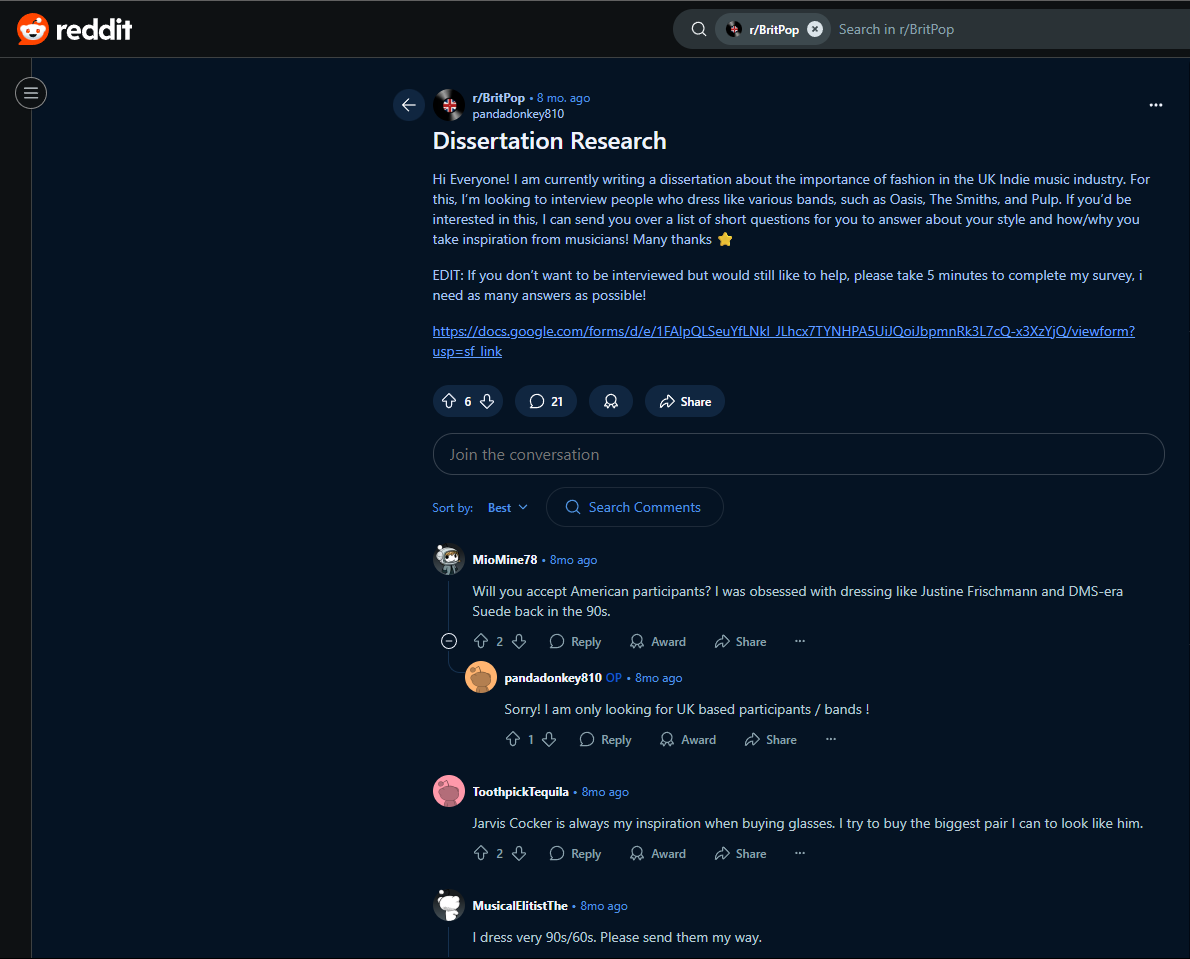
An example of active participation in Digital Ethnography in Dissertation writing

Passive Observation: Often called “lurking,” this involves observing without actively participating. While this may seem less intrusive, it still requires ethical consideration and may provide limited insights into community dynamics.

Hybrid Approaches: Many researchers combine both methods, beginning with passive observation to understand community norms before gradually increasing participation.

Tools and Techniques for Data Collection

Field Notes: Maintain detailed records of your observations, including not just what happens but your reactions and interpretations. Digital field notes might include timestamps, links to specific posts, and contextual information.

Screenshots and Archives: Capture relevant content, but be mindful of privacy and consent issues. Consider using tools that automatically archive content while anonymizing user information.

Content Analysis Tools: Platforms like Brandwatch, Hootsuite Insights, or academic tools can help track conversations and identify patterns across large datasets.

Interaction Logs: Keep detailed records of your own interactions within the community, including responses to your participation and how your presence might influence community dynamics.

Establishing a Data Collection Timeline

Digital communities operate on different rhythms than physical communities. Some are active 24/7, while others have peak activity periods. Consider:

  • Duration: How long do you need to observe to understand community patterns?
  • Frequency: Will you observe daily, weekly, or during specific events?
  • Seasonal Variations: Do community dynamics change during holidays, news events, or platform updates?

Ethical and Practical Challenges in Digital Ethnography

Navigating Privacy in Digital Spaces

The question of what constitutes “public” versus “private” in digital spaces is complex and evolving. Online ethnographic methods must carefully consider:

Platform Policies: Each platform has different privacy settings and community expectations. What’s publicly viewable may not be intended for research use.

User Expectations: Even in public forums, users may not expect their posts to be analyzed for academic research. Consider the difference between casual browsing and systematic research analysis.

Sensitive Topics: Communities discussing health issues, trauma, or other sensitive topics require extra care, regardless of their public accessibility.

Consent and Anonymization Strategies

Informed Consent: Traditional ethnography often involves explicit consent from participants. In digital spaces, this becomes more complex. Consider:

  • Whether to seek permission from community moderators
  • How to inform community members about your research
  • Whether individual consent is necessary for public posts

Anonymization Techniques: Protecting participant privacy requires more than just removing names:

  • Paraphrase rather than quote directly when possible
  • Remove identifying details from screenshots
  • Consider whether the community itself could be identified from your description

Working with Institutional Review Boards (IRBs)

Many IRBs are still developing guidelines for digital ethnography. Netnography in academic research often requires educating ethics committees about digital methods:

Prepare Detailed Protocols: Clearly explain your methods, data collection procedures, and privacy protections.

Address Platform-Specific Concerns: Different platforms present different ethical challenges. Be prepared to discuss these specifically.

Plan for Contingencies: Digital communities can change rapidly. Have plans for how you’ll handle unexpected situations or platform changes.

Responsible Research Conduct Online

Respect Community Norms: Spend time understanding unwritten rules and expectations before beginning formal data collection.

Minimize Disruption: Your presence shouldn’t significantly alter community dynamics or discussions.

Give Back: Consider how your research might benefit the communities you study. Could you share findings in ways that are useful to community members?

Analyzing and Presenting Digital Ethnographic Data

Qualitative Analysis Methods for Digital Data

Thematic Analysis: Identify patterns and themes across your digital observations. This might involve coding posts, comments, and interactions to understand recurring topics, concerns, or cultural practices.

Discourse Analysis: Examine how language is used within the community. How do members construct meaning through their digital communications? What linguistic patterns emerge?

Grounded Theory: Allow theories to emerge from your data rather than imposing predetermined frameworks. This is particularly valuable in digital spaces where new cultural phenomena are constantly emerging.

Integrating Multiple Data Types

Digital ethnography often involves analyzing text, images, videos, and interaction patterns simultaneously. Consider how these different data types work together to create meaning within the community.

Multimodal Analysis: Examine how memes, GIFs, emojis, and other visual elements contribute to community communication and culture.

Network Analysis: Consider mapping relationships and influence patterns within the community.

Tools for Digital Ethnographic Analysis

Qualitative Data Analysis Software: Tools like NVivo, ATLAS.ti, and Dedoose can help manage large datasets and identify patterns across different types of digital content.

Platform-Specific Tools: Some platforms offer analytics tools that can provide insights into community engagement patterns and content performance.

Custom Solutions: Depending on your research questions, you might need to develop custom tools for data collection and analysis.

Presenting Findings Authentically

Maintaining Voice: Find ways to present community perspectives authentically while protecting privacy. This might involve composite characters or carefully anonymized representative quotes.

Visual Representation: Consider how to represent digital culture visually in your dissertation. This might include anonymized screenshots, network diagrams, or other visual aids.

Reflexivity: Be transparent about your role as a researcher and how your presence might have influenced community dynamics.

Examples of Digital Ethnography in Dissertation Research

Case Study 1: Mental Health Support on Reddit

A recent dissertation examined how Reddit’s mental health communities create peer support networks. The researcher spent eight months observing and participating in several mental health subreddits, documenting how community members provide mutual support, share resources, and create safe spaces for discussing sensitive topics. The study revealed sophisticated community-developed strategies for crisis intervention and peer support that differed significantly from professional mental health approaches.

Case Study 2: Gaming Culture and Identity

Another researcher studied identity construction in online gaming communities, focusing on how players across different platforms develop and maintain their digital personas. By participating in gaming communities across Discord, Twitch, and game-specific forums, the researcher documented how players navigate complex social hierarchies and express aspects of their identity that might be suppressed in offline contexts.

These examples demonstrate how digital ethnography can reveal insights that would be difficult or impossible to capture through traditional research methods.

Practical Tips for Student Researchers

Getting Started with Digital Ethnography

Begin with Familiar Territory: If you’re already active in certain online communities, consider whether they might be appropriate for research. Your existing understanding of community norms and dynamics can be valuable.

Start Small: Begin with a focused community or specific aspect of online culture rather than trying to study entire platforms or broad phenomena.

Develop Digital Literacy: Ensure you understand the technical aspects of your chosen platforms, including privacy settings, content creation tools, and community features.

Maintaining Research Quality

Keep Detailed Records: Digital interactions can be ephemeral. Maintain comprehensive records of your observations, including context that might not be immediately obvious from saved content.

Practice Reflexivity: Regularly reflect on how your own background, assumptions, and presence might influence your research. Keep a reflexive journal throughout your research process.

Seek Feedback: Share your observations and emerging insights with advisors, peers, and potentially community members (where appropriate) to validate your interpretations.

Managing Challenges

Platform Changes: Digital platforms frequently update their features, policies, and algorithms. Build flexibility into your research design to accommodate these changes.

Community Evolution: Online communities can change rapidly. Be prepared to adapt your research focus if community dynamics shift significantly during your study period.

Ethical Dilemmas: You may encounter unexpected ethical situations. Establish clear protocols for handling these situations and maintain open communication with your research supervisors.

Building Relationships with Supervisors

Educate Your Committee: Your dissertation committee may not be familiar with digital ethnography methods. Be prepared to explain and justify your methodological choices clearly.

Regular Check-ins: Digital ethnography can be isolating compared to traditional fieldwork. Maintain regular contact with your supervisors to discuss challenges and insights.

Documentation: Keep detailed records of your methodological decisions and their rationales. This will be valuable for defending your approach and contributing to methodological discussions in your field.

Conclusion: Embracing Digital Ethnography for Contemporary Research

Digital ethnography represents a natural evolution of traditional ethnographic methods, adapted for our increasingly digital world. For dissertation researchers, it offers unprecedented access to authentic human interactions and cultural phenomena that are shaping contemporary society. From understanding how online communities provide mental health support to examining how digital activism influences political engagement, digital ethnography opens new avenues for meaningful, impactful research.

The methodology’s flexibility makes it valuable across disciplines, while its accessibility makes it particularly attractive for students working with limited resources. However, this accessibility shouldn’t obscure the complexity of conducting ethical, rigorous research in digital spaces. The challenges of privacy, consent, and community respect require careful consideration and planning.

As digital spaces continue to evolve and expand their influence on human behavior, researchers who master digital ethnographic methods will be well-positioned to contribute valuable insights to their fields. The key is approaching digital communities with the same respect, rigor, and ethical consideration that characterizes the best traditional ethnographic work.

For students considering digital ethnography for their dissertation research, the advice is clear: start exploring. Identify online communities that align with your research interests, begin observing their dynamics, and consider how digital ethnographic methods might help you answer questions that traditional methods cannot. The digital world is vast and full of untold stories waiting for skilled researchers to discover and share them.

By embracing digital ethnography, you’re not just adopting a research method – you’re joining a community of scholars who are pioneering new ways to understand human culture and society in the digital age. Your dissertation could contribute to this growing body of knowledge while providing insights that make a real difference in understanding our interconnected, digital world.

Data visualization in dissertation writing

Data Visualization in Dissertation Writing: How to Use Charts, Graphs, and Tables Effectively

You’ve spent countless hours collecting data, running analyses, and crafting arguments for your dissertation. Now comes the challenge that stumps many graduate students: how do you present all that valuable information in a way that actually makes sense to your readers?

Data visualization in dissertation writing isn’t just about making your work look professional—though that’s certainly a bonus. It’s about transforming complex findings into clear, compelling stories that support your research goals. Whether you’re wrestling with survey results, experimental data, or qualitative themes, the right visual approach can make the difference between a reader who gets lost in your methodology and one who clearly understands your contributions to the field.

In this guide, we’ll walk through everything you need to know about presenting data effectively in your dissertation, from choosing between charts and graphs for academic writing to mastering the technical requirements of APA format for tables and figures.

Why Data Visualization in Dissertation Matters

Picture this: you’re reading through a dissertation and encounter a dense paragraph packed with statistics, percentages, and comparisons. Your eyes glaze over, and you find yourself re-reading the same sentence three times. Now imagine encountering the same information presented in a clean, well-labeled chart. The difference is immediate and dramatic.

This scenario plays out constantly in academic reading, which is why dissertation results visualization has become such a critical skill. Visual representations help readers grasp trends, comparisons, and relationships almost instantly. Instead of forcing your committee members to decode complex numerical relationships buried in text, you’re presenting the information in a format that speaks directly to how our brains process information.

Beyond reader comprehension, effective visuals serve as powerful support for your arguments. When you claim that certain variables are correlated or that your intervention led to significant changes, a well-crafted scatter plot or line graph provides immediate, convincing evidence. This visual support becomes especially crucial during your defense, where you need to communicate complex findings quickly and clearly.

Many disciplines now expect sophisticated data presentation as a standard part of rigorous research. Whether you’re in education, psychology, business, or the sciences, your ability to present findings visually often influences how seriously your work is taken by the academic community.

There’s also a practical benefit that often gets overlooked: breaking up walls of text. Dense academic writing can be exhausting to read, and strategic placement of visuals creates natural rest points that keep readers engaged with your content.

Choosing the Right Format: When to Use What

The decision between different dissertation data presentation methods isn’t arbitrary—each format serves specific purposes and works better with certain types of information. Let’s break down when each approach shines.

Tables: Your Go-To for Precision and Detail

Tables excel when you need to present exact values, especially when those precise numbers matter to your argument. If you’re conducting survey research and need to show response frequencies across different demographic categories, a well-organized table lets readers see both the big picture and drill down into specific details.

Social sciences, health research, and technical disciplines rely heavily on tables because they accommodate large datasets without losing clarity. Consider using tables when you have categorical data that doesn’t lend itself well to visual representation, or when your readers need access to specific numerical values for their own analysis or comparison purposes.

The key to effective dissertation tables and figures lies in organization. Group related information logically, use consistent formatting throughout, and make sure your column and row headers clearly communicate what each section contains.

Bar and Column Charts: Perfect for Comparisons

When you need to compare quantities across different categories, bar and column charts are your best friends. These formats make it incredibly easy for readers to see which groups scored highest, which interventions worked best, or how different populations responded to your research questions.

These charts work particularly well for frequency data or count-based information. If you’re showing how many participants fell into different age groups, or comparing test scores across various conditions, the visual impact of bars or columns immediately communicates the relative differences.

The beauty of these charts lies in their simplicity. Readers can process the information quickly without needing to study complex visual relationships or decode complicated legends.

Line Graphs: Tracking Changes Over Time

Line graphs are indispensable for longitudinal studies or any research that examines how variables change over time. Whether you’re tracking student progress over multiple semesters, monitoring patient outcomes across treatment phases, or showing how attitudes shifted during your intervention period, line graphs tell the story of change in an intuitive way.

These visualizations work best when you have continuous data points and want to emphasize trends or patterns. The slope of the line immediately communicates whether things are improving, declining, or remaining stable, making your findings accessible even to readers who might struggle with statistical interpretation.

Pie Charts: Use Sparingly but Strategically

Pie charts have a mixed reputation in academic writing, and for good reason. They work well for showing proportions when you have a limited number of categories and want to emphasize how parts relate to the whole. However, they become problematic when you have too many categories or when the differences between segments are subtle.

In dissertation writing, consider pie charts primarily for demographic breakdowns or when you need to show percentage distributions that are central to your argument. Always ask yourself whether a simple table or bar chart might communicate the same information more clearly.

Scatter Plots: Revealing Relationships

When your research focuses on relationships between variables, scatter plots become invaluable. These graphs excel at showing correlations, outliers, and patterns that might not be obvious from statistical reports alone.

Statistics-heavy disciplines rely on scatter plots because they provide immediate visual evidence of relationships. Whether you’re examining the connection between study habits and academic performance, or exploring how different factors influence your dependent variable, scatter plots let readers see the data distribution and assess the strength of relationships for themselves.

Beyond Traditional Charts: Infographics and Concept Diagrams

Depending on your discipline and institutional guidelines, you might have opportunities to use more creative visualization approaches. Qualitative researchers often benefit from concept maps that show thematic relationships or coding frameworks. Mixed-methods studies might incorporate infographic elements that help readers understand complex methodological approaches.

However, always check with your advisor and review your program’s guidelines before incorporating non-traditional visuals. Some departments have strict requirements about acceptable visualization formats.

Best Practices That Make Your Visuals Shine

Creating effective visuals goes beyond choosing the right chart type. The difference between amateur and professional-looking dissertation results visualization often comes down to attention to detail and adherence to design principles.

Simplicity should guide every decision you make. Resist the temptation to add unnecessary elements, complex color schemes, or decorative features that don’t contribute to understanding. Your goal is communication, not artistic expression. Every element in your visual should serve a purpose.

Clear labeling cannot be overstated in its importance. Your axes must be labeled with both the variable name and units of measurement. Data sources should be obvious, either in the caption or on the visual itself. Readers shouldn’t have to guess what your numbers represent or hunt through your text to understand the context.

Consistency across your entire document creates a professional appearance and reduces cognitive load for readers. Establish a color palette, font system, and formatting approach early in your writing process, then stick to it throughout. This consistency extends to how you number figures, format captions, and reference visuals in your text.

The academic world has largely moved away from 3D effects and flashy graphics that can actually distort data interpretation. While these elements might look impressive, they often make it harder for readers to accurately assess relationships and proportions. Stick to clean, two-dimensional presentations that prioritize clarity over visual flair.

Tools That Actually Work for Academic Research

The landscape of tools for data visualization in research has expanded dramatically, but not all options are equally suited to academic work. Your choice should depend on your technical comfort level, the complexity of your data, and your institution’s software availability.

Microsoft Excel and Google Sheets remain the go-to options for many students, and for good reason. These platforms handle basic charts and graphs effectively, integrate well with statistical software, and produce visuals that meet most academic formatting requirements. While they may not offer the most sophisticated options, they’re reliable and accessible.

For students working with complex statistical analyses, SPSS, R, and Python (particularly with Matplotlib and Seaborn libraries) offer powerful visualization capabilities that integrate directly with your analytical workflow. These tools become especially valuable when you need to create multiple similar visualizations or when your data requires sophisticated statistical graphics.

Tableau, Datawrapper, and Flourish have gained popularity for their ability to create interactive and visually appealing charts. However, check whether your final dissertation format allows for interactive elements, as many institutions still require static PDFs.

For simpler needs, tools like Canva and PowerPoint can be surprisingly effective, particularly for creating flowcharts, conceptual diagrams, or basic charts that need custom formatting to match your document style.

Qualitative researchers should consider specialized software like NVivo or Atlas.ti, which can generate visual representations of coding schemes, thematic relationships, and conceptual frameworks that support qualitative findings.

Avoiding Common Pitfalls

Even well-intentioned students make predictable mistakes when incorporating visuals into their dissertations. Being aware of these common issues can save you time and improve your presentation quality.

One of the most frequent errors is mismatching chart types with data types. Using a line graph for categorical data or attempting to show correlations with a bar chart undermines the effectiveness of your presentation. Take time to consider what story your data tells and choose the format that best supports that narrative.

Many students create beautiful visuals but fail to integrate them meaningfully into their text. Your figures and tables shouldn’t exist in isolation—they should be explicitly referenced, explained, and connected to your broader arguments. Readers need guidance about what to notice and why it matters.

The opposite problem also occurs: over-visualization. Not every piece of data needs a visual representation. Use charts and graphs strategically to enhance understanding, not simply to fill space or meet an arbitrary quota. Each visual should serve a clear purpose in advancing your argument.

Technical details matter more than you might expect. Missing titles, unclear legends, or inconsistent units of measure can undermine otherwise solid research. Create a checklist of required elements and review each visual systematically before including it in your final document.

Perhaps most problematically, some students create visuals that contradict their narrative explanations. Double-check that your descriptions accurately reflect what your charts and graphs show. Discrepancies between visual and textual presentations raise questions about accuracy and attention to detail.

Integrating Visuals Into Your Dissertation Structure

Understanding how to format visuals in a dissertation involves more than creating good charts—you need to know where to place them, how to reference them, and how to ensure they comply with your style guide requirements.

The decision between in-text placement and appendix location depends on how central each visual is to your immediate argument. Figures and tables that directly support points you’re making in a specific section belong in the text, positioned as close as possible to the relevant discussion. Supplementary materials that provide additional context but aren’t essential to understanding your main points work better in appendices.

Your style guide—whether APA, MLA, Chicago, or another system—provides specific requirements for numbering, captioning, and formatting visuals. APA format for tables and figures, for instance, requires specific caption formatting, numbering systems, and placement conventions. Don’t assume these requirements are intuitive; they often differ significantly from what looks natural or aesthetically pleasing.

Effective integration means your text should prepare readers for what they’re about to see and help them interpret what they’ve seen. Phrases like “As shown in Figure 2” or “Table 3 demonstrates” create clear connections between your narrative and visual elements. More importantly, explain what readers should notice: “Figure 2 shows a clear upward trend in performance scores, with the most dramatic improvement occurring between weeks 3 and 4.”

Before submitting your final document, create a systematic review process. Check that every visual has a clear title, appropriate caption, and proper formatting. Verify that all in-text references match your numbering system. Confirm that readers can understand each visual without referring back to your methodology section.

Making Your Data Tell Its Best Story

Effective data visualization in dissertation writing is ultimately about communication. Your research represents years of work, significant financial investment, and important contributions to your field. The visuals you create should honor that investment by presenting your findings as clearly and compellingly as possible.

Remember that your committee members, future readers, and potential employers will often encounter your visuals before diving deeply into your text. These elements create first impressions and influence how seriously your work is taken. Investing time in thoughtful, well-executed visualization pays dividends in terms of impact and reception.

The goal isn’t to become a graphic design expert—it’s to become skilled at translating complex information into accessible formats that support your scholarly arguments. Whether you’re showing simple frequency distributions or complex multivariate relationships, the principles remain the same: clarity, accuracy, and purposeful design.

As you move forward with your visualization efforts, keep your readers at the center of every decision. Ask yourself whether each chart, graph, or table makes your findings more accessible and your arguments more convincing. When the answer is yes, you’re on the right track.

Your research deserves to be understood, and effective visualization is one of the most powerful tools you have for ensuring that understanding occurs. Take the time to do it well, and your dissertation will stand out for all the right reasons.

self-editing a dissertation

Professional Editing vs. Self-Editing: What’s Best for Your Dissertation?

Writing a dissertation is one of the most challenging academic endeavors you’ll ever undertake. After months or even years of research, analysis, and writing, you’ve finally reached the finish line. But wait—there’s one crucial step that can make or break your academic success: editing.

Editing isn’t just about fixing typos or adjusting commas. It’s about ensuring your dissertation communicates your research clearly, persuasively, and professionally. Errors, inconsistencies, and poor flow can undermine months of hard work, potentially affecting your grades and academic reputation.

This brings us to the central question: self-editing a dissertation or investing in professional editing services? This comprehensive guide explores both options in depth, helping you make an informed decision that aligns with your budget, timeline, and academic goals.

What is Self-Editing A Dissertation?

Self-editing involves reviewing and refining your own dissertation after completing the initial draft. This process goes far beyond simple proofreading, it’s a comprehensive review that includes grammar checks, flow adjustments, formatting tweaks, and fact-checking.

What Self-Editing Involves

Effective self-editing requires reading your work multiple times from different perspectives. You’ll need to:

  • Review content for logical flow and argument strength
  • Check grammar, spelling, and punctuation
  • Verify citations and references
  • Ensure consistent formatting throughout
  • Use editing tools like Grammarly, Hemingway Editor, or Microsoft Word’s built-in features
  • Evaluate structural consistency and coherence

Pros of Self-Editing

Cost-effective: The most obvious advantage is that self-editing is completely free. For students on tight budgets, this can be a significant factor.

Builds critical thinking skills: The process of critically evaluating your own work develops valuable analytical skills that will serve you throughout your academic and professional career.

Greater control: You maintain complete control over your tone, voice, and content. No one understands your research better than you do.

Learning opportunity: Self-editing teaches you to identify common writing mistakes, making you a stronger writer overall.

Cons of Self-Editing

Familiarity bias: After spending countless hours with your dissertation, you may unconsciously skip over errors or assume clarity where confusion exists.

Time-consuming: Thorough self-editing can take weeks or even months, especially for longer dissertations.

Lack of objectivity: It’s incredibly difficult to evaluate your own work objectively, particularly regarding flow, logic, and clarity.

Limited expertise: Unless you’re a trained editor, you may lack the technical knowledge to identify subtle issues with structure, argumentation, or academic writing conventions.

What is Professional Editing?

Professional editing involves having your dissertation reviewed and refined by a qualified editor who specializes in academic writing. These professionals bring expertise, objectivity, and fresh eyes to your work.

Types of Professional Editing

Developmental Editing: This comprehensive approach focuses on big-picture issues like structure, argument flow, clarity, and overall consistency. Developmental editors help strengthen your dissertation’s foundation.

Line Editing: This process enhances sentence-level clarity, style, and tone. Line editors work on improving readability and ensuring your writing flows smoothly from paragraph to paragraph.

Copyediting and Proofreading: The final stage involves correcting grammar, spelling, punctuation, and formatting issues. This ensures your dissertation meets academic standards and is free from distracting errors.

Pros of Professional Editing

Objective feedback: Professional editors provide unbiased, expert feedback that can significantly improve your dissertation’s quality.

Time-saving: Hiring a professional editor frees up your time to focus on other aspects of your academic work or personal life.

Polished results: Professional editing ensures your dissertation meets publication standards and presents your research in the best possible light.

Improved outcomes: A well-edited dissertation may receive higher grades and better reception from academic committees.

Expertise: Professional editors understand academic writing conventions, citation styles, and discipline-specific requirements.

Cons of Professional Editing

Cost: Professional editing services can be expensive, with costs varying based on the length of your dissertation and level of editing required.

Potential voice changes: If not properly managed, extensive editing might alter your unique academic voice (though good editors work to preserve your style).

Timeline considerations: Professional editing requires advance planning, as turnaround times may not accommodate last-minute requests.

Quality variation: The quality of professional editing services varies significantly, making it important to research and choose carefully.

Self-Editing a Dissertation  vs. Professional Editing

Feature Self-Editing Professional Editing
Cost Free Paid service ($500-$3000+)
Objectivity Low (familiarity bias) High (fresh perspective)
Time Investment High (weeks/months) Low (hours for review)
Accuracy Varies by skill level Consistently high
Feedback Depth Limited to self-awareness Comprehensive expert analysis
Tools Used Grammarly, MS Word, basic apps Human expertise + professional software
Best For Early drafts, minor revisions Final polishing, major improvements
Learning Value High (skill development) Medium (feedback insights)

When Should You Self-Edit?

Self-editing is most effective in these situations:

Budget constraints: When professional editing isn’t financially feasible, thorough self-editing is better than no editing at all.

Early draft stages: Self-editing works well for first and second drafts when you’re still developing your arguments and structure.

Minor revisions: For small formatting changes, citation updates, or basic grammar fixes, self-editing is sufficient.

Post-feedback editing: After receiving feedback from supervisors or peer reviewers, self-editing can help you implement suggested changes.

Skill development: If you want to improve your editing abilities for future projects, self-editing provides valuable practice.

When Should You Hire a Professional Editor?

Professional editing becomes essential in these circumstances:

Near submission: When you’re close to submitting your dissertation, professional editing ensures it meets the highest standards.

Non-native English speakers: If English isn’t your first language, professional editors can help refine your writing while preserving your meaning.

Complex content: Dissertations with intricate arguments, technical language, or interdisciplinary approaches benefit from professional expertise.

Lack of objectivity: When you’re too close to your work to evaluate it critically, professional editors provide necessary distance.

Time constraints: When deadlines are tight and quality is paramount, professional editing is a worthwhile investment.

Publication goals: If you plan to publish portions of your dissertation, professional editing can help meet publication standards.

Tips for Effective Self-Editing

If you choose to self-edit a dissertation, these strategies will maximize your effectiveness:

Take breaks: Allow time between writing and editing. Fresh eyes catch more errors and identify unclear passages.

Read aloud: Reading your dissertation aloud helps identify awkward phrasing, run-on sentences, and flow issues.

Print and mark: Work with physical copies when possible. Many people catch different errors on paper than on screen.

Edit in stages: Don’t try to catch everything at once. Focus on structure first, then clarity, then grammar, and finally formatting.

Use multiple tools: Combine software tools with manual review. Each tool catches different types of errors.

Create checklists: Develop systematic approaches to ensure you don’t miss important elements.

Seek feedback: Even during self-editing, getting input from peers or advisors can provide valuable perspective.

The Final Verdict: Which Should You Choose?

The most effective approach often combines both self-editing and professional editing. Here’s a strategic framework:

Start with self-editing: Use self-editing for early drafts and major revisions. This allows you to develop your arguments and fix obvious issues before investing in professional services.

Finish with professional editing: Once your dissertation is in good shape, professional editing provides the final polish that ensures academic excellence.

Consider your priorities: If budget is your primary concern, focus on thorough self-editing. If time and quality are paramount, invest in professional editing.

Evaluate your skills: Honestly assess your editing abilities. Strong writers might rely more heavily on self-editing, while those who struggle with writing mechanics benefit more from professional help.

Remember, your dissertation represents years of work and significant investment in your education. Professional editing is an investment in your academic success, potentially improving your grades, committee feedback, and future publication opportunities.

Conclusion

Both self-editing a dissertation and professional editing have their place in the dissertation process. Self-editing builds valuable skills and provides cost-effective improvement, while professional editing offers expertise and objectivity that can significantly enhance your work’s quality.

The key is being strategic about when and how you use each approach. Edit what you can confidently improve yourself, but don’t hesitate to seek professional help for areas outside your expertise. Your dissertation is too important to let perfectible issues compromise its impact.

Whether you choose self-editing, professional editing, or a combination of both, the most important step is committing to the editing process. Your research deserves to be presented in the clearest, most compelling way possible.


Organizing a literature review

The Complete Guide to Organizing a Literature Review: Expert Methods That Actually Work

Struggling with literature review organization? After helping thousands of students master their dissertations, I’m sharing the exact strategies that transform chaotic research into compelling, well-structured literature reviews.

If you’ve ever stared at dozens of research papers wondering how on earth you’re going to turn them into a coherent literature review, you’re not alone. I’ve been there, and more importantly, I’ve helped countless students navigate this exact challenge over my years as a dissertation help service.

The truth? Most students approach organizing a literature review completely backwards. They dive into writing before establishing a clear system, then wonder why their review feels disjointed and overwhelming to write.

Today, I’m sharing the three-pillar approach that has consistently helped my clients create literature reviews that not only meet academic standards but genuinely contribute to their field. Whether you’re structuring a lit review for the first time or refining your approach, these methods will save you dozens of hours and significantly improve your final result.

Why Literature Review Organization Matters More Than You Think

Before we dive into the how-to, let’s address the elephant in the room. Many students underestimate the importance of systematic organization, viewing it as busy work that delays the “real writing.” This couldn’t be further from the truth.

A well-organised literature review demonstrates critical thinking, showcases your understanding of the field’s landscape, and creates the foundation for your original contribution. More practically, proper organisation makes writing exponentially easier and helps you avoid the dreaded “I know I read something about this somewhere” moments.

In my experience, students who invest time in organising their literature review upfront consistently produce higher-quality work and experience less stress during the writing process.

Method 1: Master Your Citation Management (Your Literature Review’s Backbone)

Let me be blunt: if you’re not using a citation manager, you’re making this process ten times harder than it needs to be. After testing various tools with hundreds of students, I consistently recommend Zotero with the Zotfile extension – and here’s exactly how to use it for maximum impact.

The Professional Workflow That Changes Everything

Step 1: Active Reading with Purpose Don’t just read – engage with each source strategically. As you read, highlight key passages, including abstracts, main arguments, and any quotes you might want to reference. Most importantly, highlight sections that directly relate to your research questions.

Step 2: Extract and Organize Annotations This is where Zotfile becomes invaluable. After highlighting, use Zotfile to extract all your annotations into a notes page within Zotero. This creates a searchable database of your most important insights from each source.

Step 3: Add Strategic Metadata For each source, include:

  • A brief summary of the main argument
  • How this source relates to your research questions
  • Potential placement in your literature review structure
  • Quality assessment (methodology, sample size, limitations)

Step 4: Implement a Smart Tagging System Create tags that reflect both content themes and structural placement. For example:

  • Content tags: “motivation-theory,” “online-learning-effectiveness,” “peer-feedback”
  • Structural tags: “background,” “methodology-support,” “research-gap,” “theoretical-framework”

The Game-Changing Result Six months into your dissertation, when you vaguely remember “that study about motivation in distance learning,” you’ll find it in seconds. Your citations and bibliography practically write themselves. More importantly, you’ll have a clear map of how each source contributes to your overall argument.

Method 2: Choose Your Structural Foundation Before Writing a Single Word

Here’s where most students go wrong: they start writing before deciding how to organize their material. This approach guarantees a disjointed, confusing literature review that requires extensive revision.

Instead, choose your organizing principle early and stick to it. After analyzing hundreds of successful literature reviews, I’ve identified five structures that consistently work well:

Structure A: The Chronological Approach

The chronological approach organizes literature based on the progression of time. It is particularly useful when your research topic has evolved significantly over the years, allowing you to demonstrate how ideas, methodologies, or theoretical understandings have developed. By tracing early foundational studies, highlighting key developments over time, and discussing the most recent advancements or debates, this structure helps readers understand the historical context of your research area and how it has led to current trends.

Structure B: Broad to Specific (The Funnel Method)

This approach begins with general literature in the wider academic field and gradually narrows the focus to the specific topic being addressed. It is effective in positioning your study within the broader context while logically leading the reader toward a clearly defined research gap. Starting from general discussions and moving toward more specific studies helps build a foundation for your research and justifies the need for your particular focus or research questions.

Structure C: Theoretical Framework Focus

A literature review organized around theoretical frameworks examines the key models, theories, or conceptual approaches that underpin existing research. This structure is common in theory-driven disciplines, where multiple perspectives or conceptual tools are used to analyze the subject matter. Each section explores how scholars have applied or critiqued different frameworks, compares their usefulness, and identifies areas where existing theory may be lacking or in conflict—laying the groundwork for your own theoretical position.

Structure D: Prominent Authors or Schools of Thought

This method structures the literature based on influential scholars or schools that have shaped the field. It works particularly well in disciplines where a few key thought leaders have had a significant impact. Each section can focus on the contributions of a particular scholar or group, how their work has influenced others, and the debates or developments that have emerged in response. This approach not only shows your awareness of major voices in the field but also allows you to critically assess their influence and relevance to your study.

Structure E: Contrasting Methodological Approaches

Organizing by methodology is ideal for topics where different research approaches offer varied insights. This structure presents the literature according to the methods used—such as quantitative, qualitative, or mixed methods—and analyzes how each approach contributes to understanding the research problem. It also highlights the strengths and limitations of different methods and identifies any methodological gaps that your study might address. By doing so, it provides a comprehensive view of how the topic has been studied from different angles.

Hybrid Structures: Combining Approaches

Many effective literature reviews use a hybrid structure, blending elements from multiple organizational styles. For instance, you might organize your main sections thematically or by theoretical perspective, while discussing the literature within each section in chronological order. This allows for both a structured and nuanced presentation of the literature, especially when the topic spans several domains or methodological traditions.

Method 3: The Slip-Box System for Deep Insights

While citation managers handle the logistics, the slip-box method (also known as Zettelkasten) transforms how you think about your sources. This isn’t just note-taking – it’s a system for building genuine insights that will elevate your literature review from summary to synthesis.

How to Implement the Slip-Box Method for Literature Reviews

Create Atomic Notes Write one key idea per note, always in your own words. Each note should be self-contained and understandable months later. Include the full citation and page numbers for easy reference.

Build Conceptual Links As you create notes, actively look for connections. How does this finding relate to other studies? Does it support or challenge previous work? These connections become the foundation of your analytical arguments.

Develop Argument Chains Link related notes together to build chains of reasoning. For example: “peer feedback effectiveness” might connect to “motivation theory” and “online learning engagement,” creating a pathway for a sophisticated argument about feedback mechanisms in digital education.

Regular Review and Clustering Periodically review your growing collection of notes, looking for emerging patterns or themes. These natural clusters often become the sections of your literature review.

Why This Method Works

The slip-box method forces you to engage deeply with each source rather than simply collecting quotes. By the time you start writing, you’ve already done much of the analytical thinking. Your literature review becomes a matter of organizing and connecting insights you’ve already developed, rather than trying to generate analysis while simultaneously managing dozens of sources.

Advanced Organisation Strategies for Complex Literature Reviews

Managing Large Bodies of Literature

When dealing with extensive literature (100+ sources), consider creating a hierarchical organization system:

  1. Primary sources: Seminal works that define your field
  2. Secondary sources: Studies that build on or respond to primary works
  3. Supporting sources: Additional evidence or examples
  4. Contextual sources: Background information or related fields

Handling Contradictory Findings

Don’t avoid sources that contradict your expectations – they’re often the most valuable for developing nuanced arguments. Create a systematic approach:

  1. Acknowledge contradictions explicitly
  2. Analyze potential reasons (different methodologies, contexts, populations)
  3. Position your research in relation to these debates
  4. Identify opportunities for your work to contribute clarity

Quality Control Throughout the Process

Implement regular quality checks:

  • Relevance review: Does each source directly contribute to your research questions?
  • Balance assessment: Do you have adequate coverage of different perspectives?
  • Currency check: Are you including recent developments in the field?
  • Methodology diversity: Have you considered different research approaches?

Common Pitfalls in Literature Review Organisation (And How to Avoid Them)

The Collection Trap

Problem: Endlessly collecting sources without organizing or analyzing them.

Solution: Set limits. After reaching 30-40 relevant sources, focus on deep analysis rather than continued collection.

The Summary Syndrome

Problem: Describing each study individually without showing connections.

Solution: Use your organizational structure to group related studies and emphasize synthesis over summary.

The Perfection Paralysis

Problem: Waiting until you’ve read “everything” before starting to organize.

Solution: Begin organizing after your first 10-15 sources. Your system will evolve, and that’s perfectly normal.

The Structure Switching

Problem: Changing organizational approaches midway through writing.

Solution: Commit to your chosen structure early and stick with it. You can always refine within that framework.

Your Literature Review Organization Action Plan

Ready to implement these strategies? Here’s your step-by-step roadmap:

Week 1: Foundation Setup

  • Install and configure Zotero with Zotfile
  • Develop your tagging system
  • Choose your primary organizational structure
  • Create templates for note-taking

Week 2-4: Active Collection and Analysis

  • Read and annotate sources using your established system
  • Create slip-box notes for key insights
  • Begin identifying connections and themes
  • Regularly review and adjust your organization

Week 5-6: Structure Refinement

  • Group sources according to your chosen structure
  • Identify gaps in coverage or argument
  • Create detailed outlines for each section
  • Plan transitions between major themes

Week 7+: Writing with Confidence

  • Begin drafting with your organized materials
  • Use your slip-box connections for sophisticated analysis
  • Maintain your organizational system as you write
  • Regular review prevents scope creep

Tools and Resources for Organizing A  Literature Review

Essential Software

  • Zotero + Zotfile: Free, powerful, and integrates with most word processors
  • Obsidian or Roam Research: For advanced slip-box implementation
  • Scrivener: Excellent for managing large writing projects
  • Mind mapping software: For visualizing connections (XMind, MindMeister)

Backup and Security

Always maintain multiple backups of your organized literature. Use cloud storage and consider exporting your Zotero library regularly. Losing months of organizational work is devastating and entirely preventable.

Conclusion: From Chaos to Clarity

Literature review organisation isn’t just about keeping track of sources – it’s about building the intellectual foundation for original, impactful research. The methods I’ve shared here represent years of refined practice and have consistently helped students transform overwhelming research tasks into manageable, rewarding experiences.

Remember, the goal isn’t perfection from day one. Start with these systems, adapt them to your specific needs, and maintain consistency in your approach. Your future self – the one sitting down to write with beautifully organized, deeply understood sources – will thank you.

The difference between a mediocre literature review and an outstanding one often comes down to organization. Students who master these methods don’t just write better literature reviews; they develop research skills that serve them throughout their academic and professional careers.

Start with Method 1 today. Set up your citation management system, read one source using the active annotation approach, and create your first slip-box note. Small, consistent actions compound into significant results.

Your literature review doesn’t have to be a source of stress and confusion. With proper organisation, it becomes a powerful tool for demonstrating your expertise and setting up your original contribution to the field.

Ready to take your literature review to the next level? These organizational methods are just the beginning. For personalized guidance on structuring your specific literature review, consider working with experienced dissertation consultants who can help you navigate the unique challenges of your field and research questions.

Need Expert Help with Your Literature Review?

If you’re feeling overwhelmed by the scope of your literature review or need personalized guidance for your specific research area, you don’t have to navigate this alone. At Custom Dissertation Service, we’ve helped thousands of students master their literature reviews across every academic discipline.

Our experienced dissertation consultants specialize in:

  • Literature Review Organization and Structure – Get your sources properly categorized and logically arranged
  • Critical Analysis Development – Transform summaries into sophisticated synthesis and argumentation
  • Research Gap Identification – Position your work within existing scholarship effectively
  • Citation and Methodology Guidance – Ensure academic rigor throughout your review

Whether you need help getting started, overcoming writer’s block, or refining a draft that isn’t quite working, our team understands the unique challenges of literature review writing. We work with your timeline, your university’s requirements, and your specific research goals to create a literature review that truly supports your dissertation’s success.

Ready to transform your literature review from overwhelming to outstanding? Contact Custom Dissertation Service today for a consultation tailored to your specific needs and academic requirements.